A design principle
A kid asked AI to design "the strongest bridge ever." We built it out of cardboard. It collapsed in seconds. She looked at the pile, then grinned: "Can we try again?"
→ that's a touchdown
Technology is the runway.
Transfer is the touchdown.
We believe digital learning experiences shouldn't be measured by how long a child stays on the screen — but by what happens the moment they leave it.
exhibit A
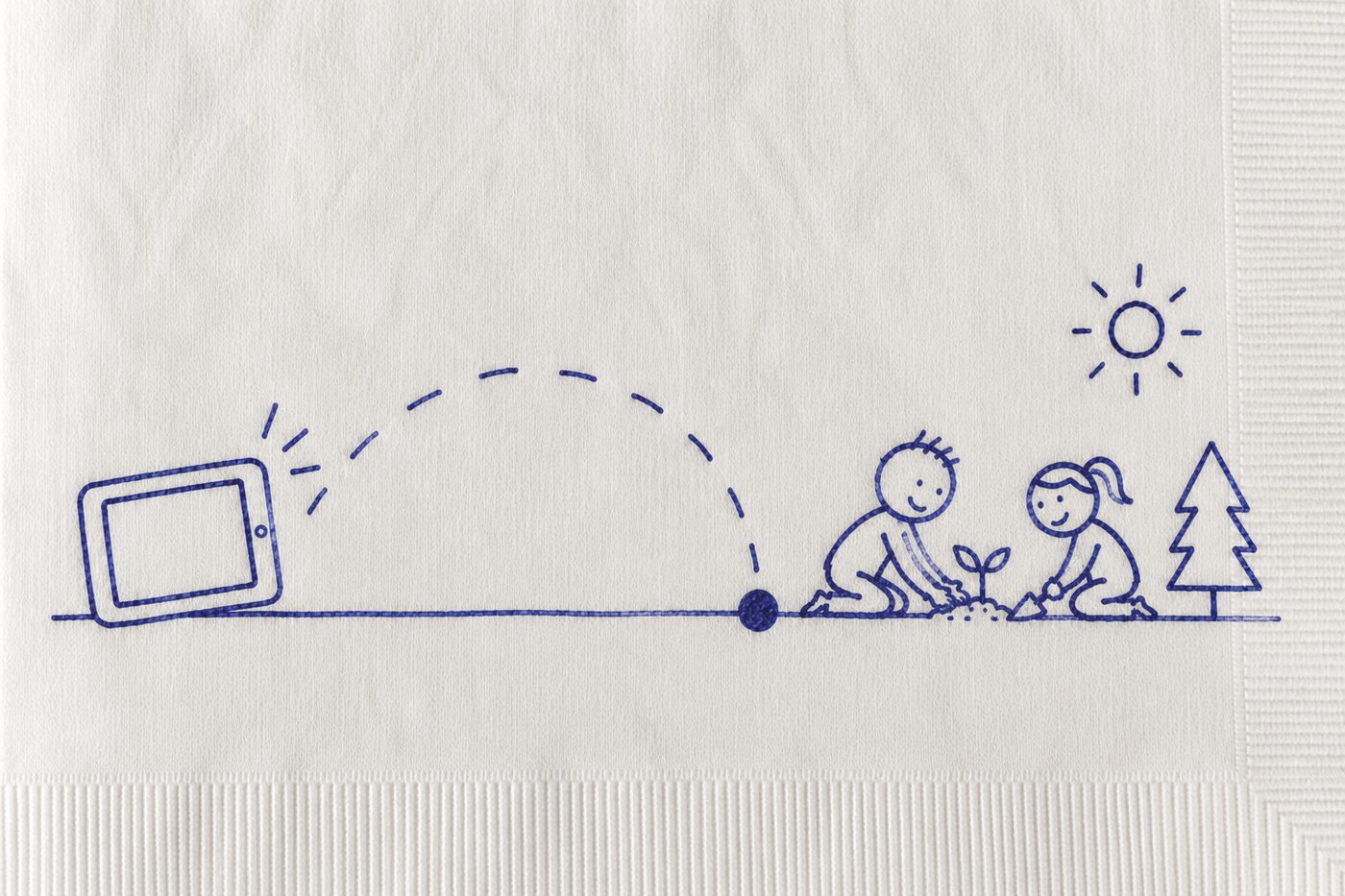
the idea, sketched on an actual napkin
The wrong question
Most educational apps are closed loops. A child opens the app, completes a task, earns a badge, closes the app. The learning begins and ends inside the software.
The best learning experiences work differently. They're open loops — they don't end when the screen does. They spill into conversations, experiments, muddy shoes, arguments at the dinner table about who's actually right.
We keep asking kids the wrong screen time question. "How much" treats screen time like it's one activity. It isn't. Watching a video and designing a robot happen on the exact same piece of glass — they are not remotely the same experience, for the brain or for what happens next.
So maybe the better question isn't how much. It's: where does this screen time lead?
The runway
A screen should be a runway, not a destination. A simulation shows how cloud types form — that's the takeoff. A kid steps outside, matches the real clouds overhead to what she just learned, and predicts the next few hours — that's the landing.
Most digital products are optimized for keeping kids on the runway as long as possible: longer sessions, more time in-app, higher retention. But a runway was never supposed to be the destination. It exists to launch something else.
The best digital experiences for kids don't hold their attention. They redirect it — back into the room, outside, into a conversation.
digital worldreal world
AI
App
Video
Robot
→
Tablet
Learn
→
Touchdown
Build · Test
Discuss · Observe
→
Transfer
Play
Runway. Touchdown. Transfer event. The screen is the runway — it introduces a topic, sparks curiosity, frames a problem. The touchdown is the deliberately designed moment of landing: a concrete action outside the screen. The transfer event is the observable result — a model that got built, a conversation that got had, something noticed outside. Runway and touchdown are designed to sit close together in time.
Technology is the runway.
Transfer is the touchdown.
Runway and touchdown stay close together in time.
Zooming in on the bridge
On screen, the design was flawless: wide supports, elegant arches, a confident explanation for why it would hold. That's what AI is good at — generating the possibility.
exhibit B — the actual bridge
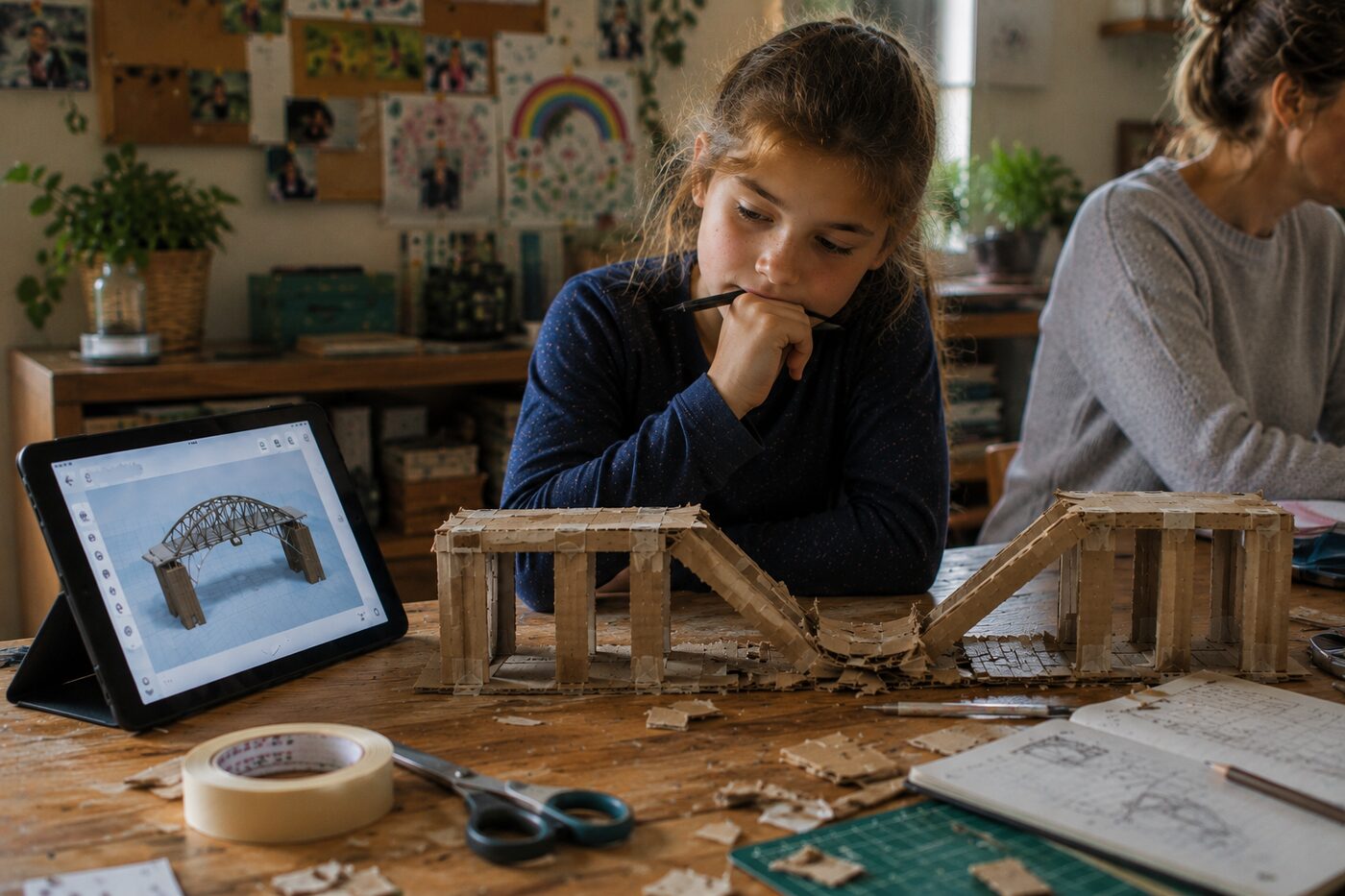
Cardboard, gravity and an eight-year-old's hands did the rest. The bridge came down before we'd even let go of it.
What mattered wasn't the collapse. It was the ten seconds after — the retry, the theory-fixing, the second attempt that actually stood. That's where the real learning happened. The AI couldn't have done that part. Neither could the child, alone.
MARION SCHOENEGGER — 18 YEARS IN TECH AND PRODUCT. CURRENTLY BUILDING THIS INTO DIGITAL PILOTS — AND TESTING IT, ONE COLLAPSED CARDBOARD BRIDGE AT A TIME.
The full essay is almost ready.
A new framework for designing digital experiences that lead to real-world learning.